
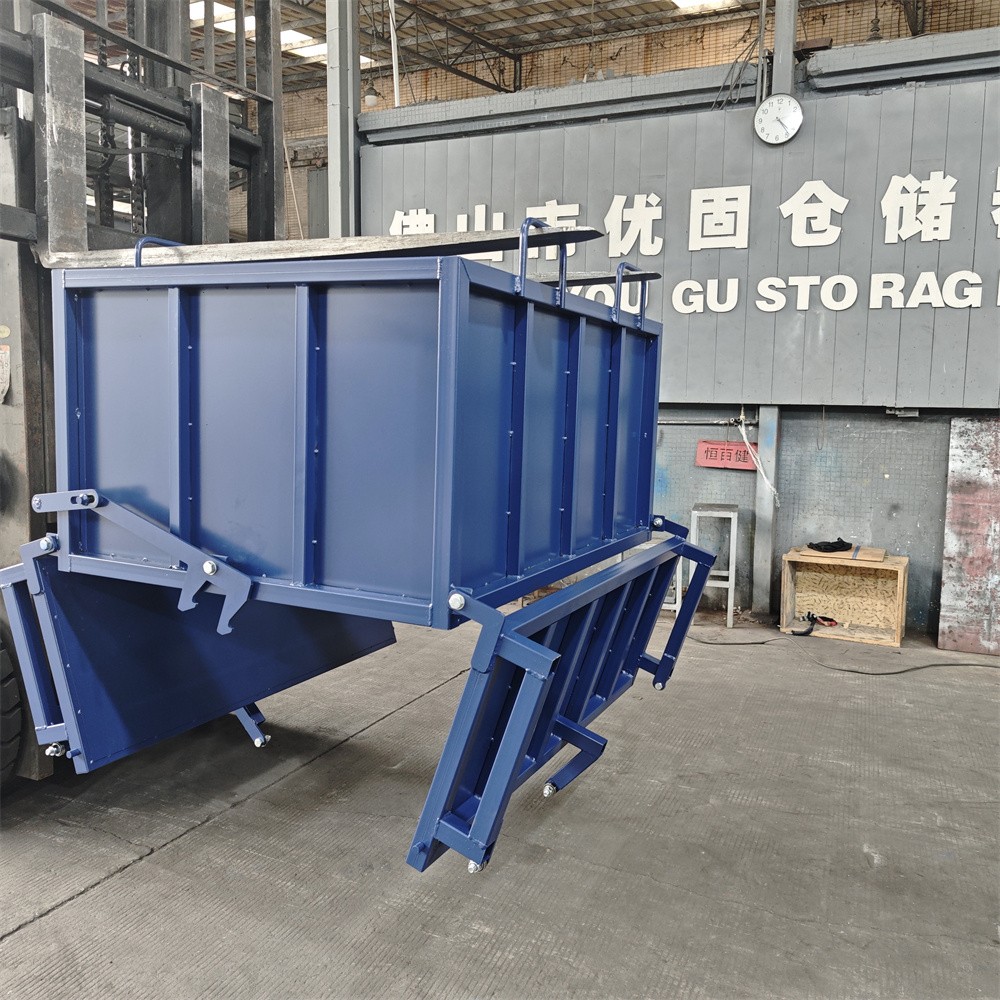
A steel drop bottom waste bin is a rigid plate-body container with a floor that opens underneath, so the load falls clear instead of relying on the whole body tipping. It is the container used where the waste will not slide out of a conventional skip — wet green waste, food waste, clay, slurry, and scrap that bridges across the opening.
This is a solid steel plate bin, not a mesh cage. The body is welded plate with external stiffening ribs, and it is built for containers that stay outdoors in a yard and get loaded by machine. Mesh cages have their place for dry, light, hand-loaded waste; a plate body is what a waste contractor actually runs.
| Item | YG-DB series |
|---|---|
| Type | Steel drop bottom waste bin / Marrel-type skip container |
| Body | Welded steel plate with external vertical and horizontal stiffening ribs |
| Floor | Two hinged drop leaves, released by the lifting gear as the body is set down or lifted |
| Discharge options | Drop bottom / front lift / drop end gate — set by the vehicle or hooklift you run |
| Size | Customized — built to the volume and lifting geometry you specify |
| Load rating | Within 300 – 3,000 kg, confirmed per design |
| Material | Mild steel plate; floor and lower sides specified heavier than upper panels |
| Finish | Hot-dip galvanised, or powder coated to your colour |
| Lifting | Hooklift lugs, skip loader hooks or forklift pockets — to your drawing |
| Options | Lid, plate holder or stencilled ID panel for weighing, wear strips on the floor |
| Remark | Customized or OEM support |
Why a plate body rather than a mesh cage
Waste handling is an abrasion problem. A mesh side lets material press into the wire and works it back and forth every time the bin is moved, so the wire wears at the welds and the cage starts to shed material. A plate side spreads that load across a surface, and when it does wear you weld a patch on rather than replacing a panel.
Mesh still has a job: light, dry, hand-sorted waste where you want to see the contents and the bin never gets loaded by machine. We build both. If you are not sure which you need, the question is how the bin is filled — by hand, or by a machine that drops the load in.
Collapsible or rigid
Both are available. A rigid body is the default for a working container: it holds its shape under a heaped load and it does not have joints to wear. A collapsible body saves volume on the return leg, which only matters if the bins are being shipped empty rather than staying in service on one site. For most fleets the rigid body is the right answer, and the collapsible is a transport decision rather than a product decision.
Sizing
Australian and New Zealand buyers order these by cubic metre — 2, 3, 4, 6, 8 and 10 m³ are the sizes quoted in the trade. Two things decide the build: the volume you need per collection, and the lifting geometry of the truck. Volume is nominal, so if you are buying against a weight limit as well as a volume, tell us — it changes the floor gauge and the rib spacing.
Processing and quality control
Plate is cut and formed in-house, the body is jig-welded so the diagonals stay square, and the drop leaves are fitted to the frame before coating rather than after, so the hinge line is set on the finished body. Each batch is checked for incoming steel, weld quality, dimensions and coating, and third-party inspection is welcome at any stage.
Frequently asked questions
What is a drop bottom bin used for? Wet, sticky or stringy waste that will not tip out of a normal skip — green waste, food waste, clay, slurry, and scrap that bridges. The floor opens underneath so the material has nowhere to hang up.
Can you build to our truck’s lifting gear? Yes. Send the hooklift or skip loader specification, or a photograph of an existing bin on the truck, and we build the lifting points to match rather than supplying a generic set of lugs.
Do you make both mesh and plate waste bins? Yes. Plate is the standard for machine-loaded waste; mesh is used for dry, light, hand-loaded material where visibility matters.
Send your message to us:
